What marketing trends should businesses watch this year? (2026)
Roughly a quarter of people who use AI tools are already using them to shop, according to HubSpot’s 2026 research. Sit with that for a second. A growing share of your customers are no longer browsing your website, weighing your reviews, or noticing your clever ad. They are asking an assistant to do all of that for them, and acting on whatever it recommends.
That single shift reframes almost every trend worth watching in 2026. The headline this year is not that AI helps marketers do more. It is that, for the first time, a meaningful part of your audience is not human at the moment of decision.
Why this matters right now
The reason it is happening now is simple: the plumbing finally exists. New standards such as the Agentic Commerce Protocol and the Model Context Protocol let brands plug real transactions directly into AI chat interfaces, so an assistant can compare options, check stock, and buy without anyone visiting a site. On the marketer’s side, automation is accelerating fast. HubSpot’s 2026 State of Marketing report found that around 19% of marketers already run campaigns end to end with AI agents, and Gartner expects those agents to absorb routine customer engagement entirely, collapsing the old channel-by-channel playbook.
So the real question for 2026 is not “how do I use AI?” It is “who, or what, am I actually marketing to?”
Five things I'd want every business to sit with
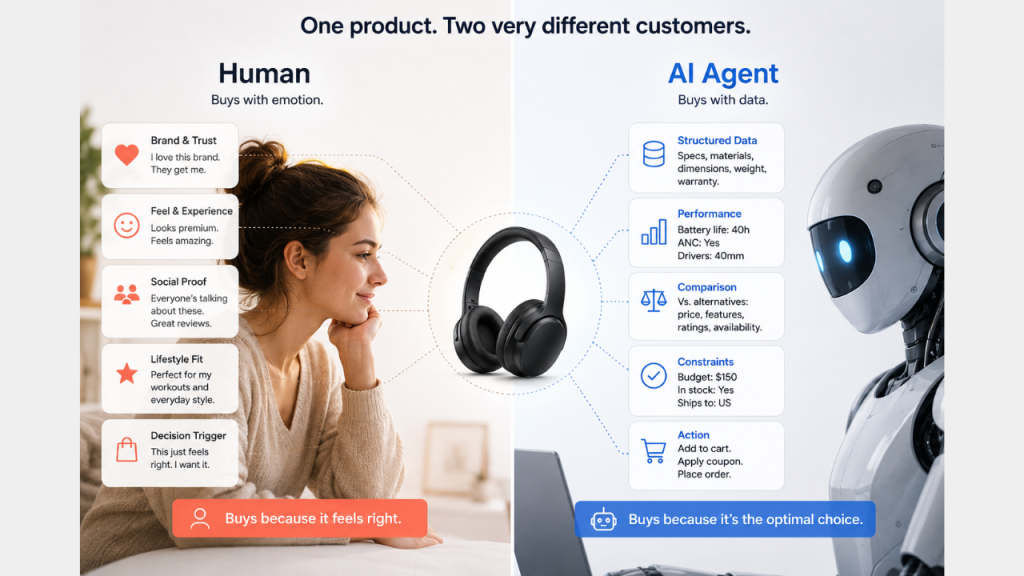
You now have two customers, and they want opposite things. The human still wants to feel something: trust, recognition, reassurance. The machine wants the opposite, namely clean, structured, accessible data it can read and act on instantly. Most businesses are built to charm the human and confuse the machine. Winning this year means designing for both at once, which almost nobody is doing well yet.
“Agent readability” is becoming the new SEO. If an AI agent cannot parse your pricing, availability, and product details through structured data and APIs, you simply will not appear in its recommendation. You can own the strongest brand in your category and still be invisible to the software doing the shopping. The brands treating their product data as a marketing asset, rather than an IT afterthought, will quietly pull ahead.
As machines mediate more, human authenticity becomes more valuable, not less. This is the contradiction I find most fascinating. The more AI floods feeds and inboxes, the more people hunt for proof that something real sits behind the message. Gartner found that half of US consumers would rather buy from brands that avoid using generative AI in their content, and it predicts verified creators and authenticity will define influence in 2026 as deepfakes make trust scarce. Automation raises the price of the genuinely human touch.
The marketing team is flattening. As agents take over execution, the work that survives is judgement: taste, strategy, narrative, and knowing which questions are worth asking. Gartner expects marketing organisations to reorganise into leaner, more modular shapes. Roles tied to manual output are exposed. Skill tied to thinking is not.
What to actually do about it
Start by auditing your brand through a machine’s eyes. Is your product data structured, current, and accessible enough for an agent to confidently recommend you? Then double down on what AI cannot fake: real expertise, real customer stories, and a distinct point of view. Keep a human reviewing anything customer-facing, because one robotic misfire now costs trust you spent years building. Finally, move your metrics away from raw traffic and volume toward trust signals and conversion quality.
Where this goes next
Over the next three to five years, expect a clean split. Bain & Company found that about half of consumers are still cautious about fully autonomous purchases, so this will not happen overnight, but the direction is set. Brands that learn to speak to both the algorithm and the person will compound their advantage. Those who commit to only one side, whether all-in automation or stubborn nostalgia for the old playbook, will struggle.
The opportunity in 2026 is not to chase every trend. It is to notice that they all point at the same thing: marketing is becoming a conversation between humans and machines, and the smartest brands are learning to be fluent in both.
Aamir Jolly is a digital marketing strategist and trend forecaster with 8+ years of experience across SEO, AI-powered marketing, content strategy, paid media, and business growth, working with local and international clients.
Sources & Further Reading
- HubSpot (AI Marketing Predictions) – https://blog.hubspot.com/marketing/ai-predictions-marketing
- HubSpot State of Marketing – https://www.hubspot.com/state-of-marketing
- Gartner (The Future of Marketing: 2026 Predictions) – https://www.gartner.com/en/articles/future-of-marketing
- Gartner (Survey: 50% of Consumers Prefer Brands That Avoid Using GenAI) – https://www.gartner.com/en/newsroom/press-releases/2026-03-16-gartner-marketing-survey-finds-50-percent-of-consumers-prefer-brands-that-avoid-using-genai-in-consumer-facing-content0
- Retail Customer Experience (citing Bain & Company, “Agentic AI in Retail”) – https://www.retailcustomerexperience.com/articles/2026-will-be-the-year-of-agentic-ai/