Why getting noticed has never been easier and why it matters less than ever
There’s a contradiction playing out in marketing right now that almost nobody is naming out loud.
On one side, senior marketers are sprinting toward AI. A Billion Dollar Boy study found that 77% of senior marketing decision-makers plan to shift budget away from traditional creator work and toward generative-AI content. On the other side, the people they’re trying to reach are quietly backing away. Gartner’s October 2025 survey of more than 1,500 U.S. consumers found that half of them (50%) would rather buy from brands that don’t use generative AI in their content at all.
Read those two numbers together and you see the trap forming. The industry is optimising hard for the one thing that’s becoming worthless – attention – while neglecting the one thing that’s becoming priceless: trust.
I’ve spent the last eight years watching this gap widen across local and international clients, and I’m convinced it’s the defining strategic question of the next five years. So let me unpack why it’s happening, and what I’d actually do about it.
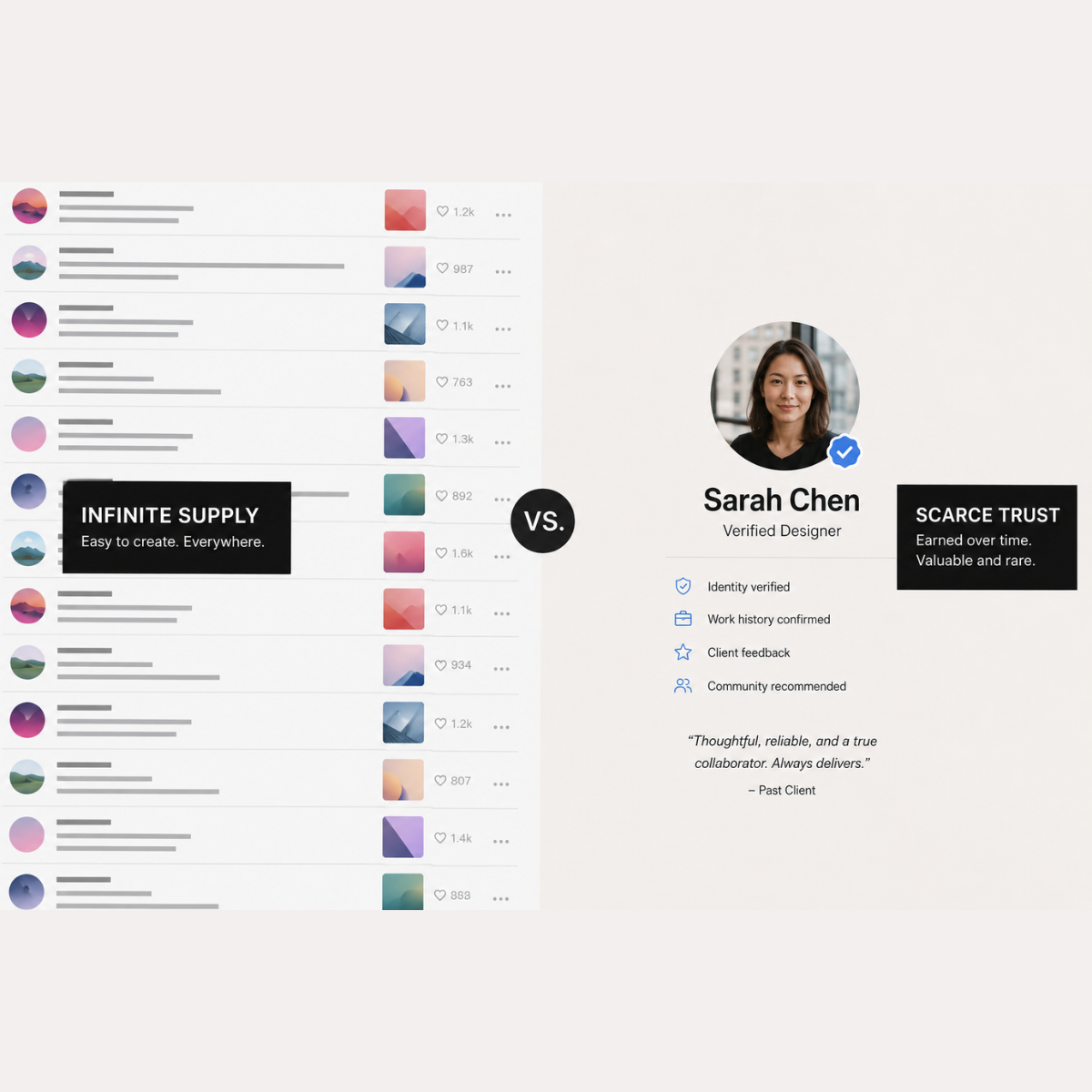
Suggested Image: A split-screen illustration one side showing an overflowing social feed of generic AI content, the other a single handshake or verified profile. Visual metaphor for “infinite supply vs. scarce trust.”
Attention became a commodity the moment content became free to make
Here’s the part most strategy decks skip: attention is now cheap because production is now free.
According to data from Graphite cited by EMARKETER, AI-generated articles made up roughly 51.7% of all new English-language content online by 2025, up from just 7.8% when ChatGPT launched in late 2022. In under three years, the internet went from mostly-human to mostly-machine. When supply explodes like that, the price collapses. That’s not a marketing opinion; it’s basic economics applied to content.
So when a brand celebrates “we can now produce 40x more content,” I hear “we’re now competing in the most oversupplied market in history.” Volume stopped being a moat the day everyone got the same tools.
The trust penalty is real, measurable, and growing
What replaces volume? The thing that doesn’t scale.
The data here is striking. Klaviyo and Datalily found in December 2025 that only 7% of consumers trust a brand more when they see visibly AI-generated content — while 31% trust it less. Gartner’s work points the same direction: 68% of consumers now frequently wonder whether the content they’re seeing is even real.
This is the psychological shift I find most fascinating. We are watching the birth of default skepticism. For most of marketing history, the consumer’s baseline was mild belief — they assumed what they saw was broadly genuine until proven otherwise. That baseline has flipped. The new default is “prove it.” And once you have to earn belief from a standing start on every single impression, attention without credibility is just noise you paid for.
Trust has quietly become a purchase driver, not a nice-to-have
Meanwhile, trust isn’t just defensive — it’s become a hard commercial lever.
The 2025 Edelman Trust Barometer surfaced something genuinely new: trust now sits alongside price and quality as a top-tier purchase consideration, and 80% of people say they trust “my brands” — the ones they personally use — far above their trust in government, media, or institutions generally.
Sit with that. Consumers have lost faith in almost every large institution, and they’ve redirected that need for stability onto the brands in their daily lives. That’s an enormous opportunity, but it comes with a bill attached: the moment a brand betrays that trust, the fall is steep. Emplifi found that 52% of consumers will stop buying from a brand after a single inauthentic experience. One bad AI-generated campaign, one tone-deaf automated message, and you’ve spent goodwill that took years to bank.
Why this is happening: the incentives are misaligned
The uncomfortable truth is that the people making content decisions and the people receiving content are optimising for opposite outcomes.
Marketers are measured on output, reach, and cost-per-asset — all of which AI improves overnight. Consumers care about whether they’re being respected, told the truth, and sold something worth their money — none of which AI improves automatically. So the tools reward the marketer for doing exactly what erodes the consumer relationship. Left unchecked, efficiency quietly cannibalises equity.
What I'd actually do about it
Strategy is useless without application, so here’s what I tell the founders and teams I work with:
- Treat AI use as a trust decision, not just a cost decision. Before automating anything customer-facing, ask: “Does this make the customer’s life better, or just our margins better?” If it’s only the latter, slow down.
- Use AI to draft, never to decide. The winning workflow I keep seeing is AI for the first 80% (research, variations, structure) and a real human for the last 20% — the judgment, the edge, the brand voice. Klaviyo’s own guidance is blunt: don’t cut human review. That last 20% is where trust lives.
- Build proof into your content. With 68% of people doubting what’s real, citations, real testimonials, named experts, and verifiable claims are no longer “extra credibility” — they’re the price of being believed at all.
- Invest in the channels machines can’t flood. In-person experiences, owned communities, genuine expertise, and a recognisable human point of view are getting more valuable precisely because AI content is getting cheaper. Scarcity is where the margin is.
Where this goes next
Over the next three to five years, I expect “trust signals” to become as central to marketing strategy as SEO was in the 2010s. We’ll see verification, provenance labelling, and human-authorship as competitive features, not compliance checkboxes. The brands that treat AI as a volume machine will blend into the 50% of content nobody believes. The brands that treat AI as leverage for more human work — faster research, sharper thinking, deeper personalisation done respectfully — will own the only territory left worth owning.
Attention will keep getting cheaper. Trust will keep getting harder. And in a market where everyone can produce everything, the brand people actually believe wins by default.
That’s the moat. Build it deliberately.
Aamir Jolly is a digital marketing strategist and trend forecaster with 8+ years of experience across AI-powered marketing, content strategy, SEO, paid media, and business growth, working with local and international clients.
Sources & Further Reading
- Edelman — 2025 Edelman Trust Barometer, Special Report: Brand Trust, From We to Me (trust now equal to price and quality; 80% trust “my brands”)
- Gartner — Marketing Survey: 50% of Consumers Prefer Brands That Avoid Using GenAI in Consumer-Facing Content (survey of 1,539 U.S. consumers, fieldwork Oct 2025); and Survey Finds 53% of Consumers Distrust AI-Powered Search Results (Sept 2025)
- Klaviyo & Datalily — Consumer Trust in AI (Dec 2025); the 7% trust-more / 31% trust-less figures for visible AI content as reported by EMARKETER
- EMARKETER / Graphite — How Marketers Are Trying to Win Consumer Trust in the AI Age (AI-generated articles reaching ~51.7% of new English-language content, 2025)
- Emplifi — Consumer research on inauthentic experiences (52% stop buying) and AI disclosure expectations, as reported by EMARKETER
- Billion Dollar Boy — Survey on marketers shifting budgets toward genAI creator content (77%), as reported by EMARKETER
- Meltwater / YouGov — Do Consumers Trust AI-Generated Content? (51% skeptical vs. 39% excited about generative AI)